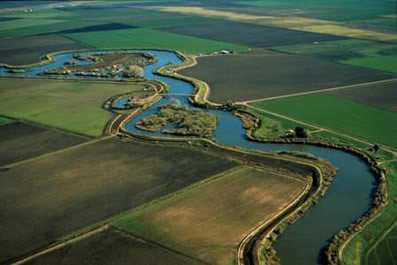
 Following seven years of extensive scientific review, public meetings, collaboration and compromise by many competing interests, the public draft of the Bay Delta Conservation Plan (BDCP) and associated environmental impact documents were released in December 2013 for formal public review and comment. The BDCP is a state/federal plan aimed at achieving the co-equal goals of restoring both the Delta ecosystem and water supply reliability for 25 million Californians, including those living in Zone 7's service area.
On August 27, 2014, it was announced that the state Department of Water Resources and the other state and federal agencies leading the BDCP will publish a Recirculated Draft BDCP, Environmental Impact Report/Environmental Impact Statement (EIR/EIS), and Implementing Agreement (IA) in early 2015. The agencies are currently reviewing the comments received through the public comment period that ended on July 29, 2014. The scope of the partially recirculated draft documents will be announced in October or November 2014.
The documents and other information can be viewed on the BDCP website, www.baydeltaconservationplan.com.
Zone 7's Reliance on the Delta
More than 80 percent of the water delivered by Zone 7 to utilities serving Pleasanton, Livermore, Dublin and Dougherty Valley is Sierra snowmelt captured by the State Water Project and conveyed through the Delta, making a Delta solution imperative for the Tri-Valley's economic vitality and continued quality of life. Without this imported supply, businesses, the wine industry, firefighting and other public health and safety needs could not be met.
To learn more about the Bay Area's reliance on the Delta, read the "Restoring the Delta -- Protecting Our Future" document published by South Bay Aqueduct water contractors -- Zone 7, Santa Clara Valley Water District and Alameda County Water District.
To view information about the BDCP from the State Water Contractors, of which Zone 7 is a member, click here.
The Problem
Water for the state and federal water projects is conveyed through the Delta's 1,100-mile network of fragile levees that protect islands that have sunk by as much as 25 feet over the decades. The health of the Delta estuary faces mounting pressures related to invasive species, as well as threats of seawater intrusion from flooding, earthquakes and rising sea levels due to global climate change. In addition to other stressors on the Delta, including contaminants from agricultural drainages, wastewater treatment plant discharges, recreational activities and upstream diversions, the existing system of water conveyance has created unnatural north-south flows in the Delta, confusing native species and disturbing the ecosystem.
Operations of the state and federal projects are limited by regulatory requirements, including those issued by state and federal fishery agencies to protect threatened and endangered fish species. Since 2007, projected long-term average deliveries to Zone 7 from the State Water Project have been reduced from 76 percent of contract amounts annually to about 60 percent.
Zone 7 has enough stored groundwater and other emergency reserve supplies to meet projected demands for the next several years. But without a Delta conveyance fix, the agency faces an uncertain future with water-supply reliabilty that conservation alone cannot address. While Zone 7 is working on additional fronts to diversify its water sources, the agency will always rely on Delta conveyance for most of its water supply.
Proposed Delta Conveyance
In addition to extensive habitat improvements, the BDCP calls for construction of two new water supply tunnels, from the northern Delta to existing aqueduct facilities in the south Delta, to restore reliability and avoid seismic and other risks. Through ongoing evaluation and compromise, the proposed capacity of the conveyance facilities has been reduced by 40 percent, from 15,000 cubic-feet-per-second (cfs) to 9,000 cfs. The improved conveyance would be large enough to capture sufficient wet-weather supplies to maintain the state's groundwater basins and surface water reservoirs, while still requiring urban communities to stay on the path of conserving and recycling water. If a new conveyance system is built, the benefiting water agencies (including Zone 7) would pay for construction and related environmental mitigation.
More About the BDCP
The BDCP is a statewide effort involving local water agencies, environmental groups, state and federal wildlife agencies and other interested parties. It addresses co-equal goals of water reliability and the failing Delta ecosystem holistically -- and not in a piecemeal, haphazard, species-by-species fashion in response to lawsuits and piecemeal regulation.
The plan is being developed in compliance with the Federal Endangered Species Act (ESA) and the California Natural Communities Conservation Planning Act (NCCPA). When complete, the BDCP will provide the basis for the issuance of endangered species permits for the operation of the state and federal water projects. The plan would be implemented over the next 50 years.
The BDCP provides a regulatory path for project proponents to agree to implement a collection of habitat restoration measures and water operations criteria in return for regulatory approval of the necessary long-term permits.
The Bay-Delta:
-
is a key drinking-water water supply for 25 million Californians, including about 3 million in the Bay area (more than 200,000 specifically in Zone 7's service area).
-
drains 40 percent of the state's surface area and is the largest estuary on the West Coast.
-
is home to almost 600 different species of fish, animals, birds and plants, plus more than 130 invasive, nonnative species of concern.